In this post, I will show you a simple and easy way to display the GridView record Vertical. Check out the following code snippet, which is self-explanatory.
[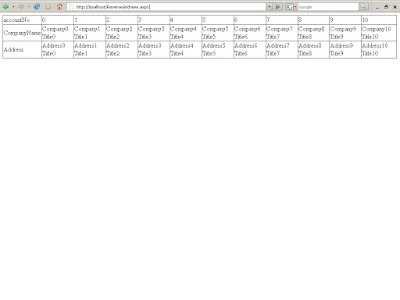 ]
]
<%@ Page Language="C#" AutoEventWireup="true" CodeFile="FlipGridView.aspx.cs" Inherits="XmlPostData" %>

<!DOCTYPE html PUBLIC "-//W3C//DTD XHTML 1.0 Transitional//EN" "http://www.w3.org/TR/xhtml1/DTD/xhtml1-transitional.dtd">
<html xmlns="http://www.w3.org/1999/xhtml">
<head runat="server">
<title>Untitled Page</title>
</head>
<body>
<form id="form1" runat="server">
    <div>
        <asp:GridView ID="GridView1" runat="server" ShowHeader="false" AllowSorting="true">
        </asp:GridView>
    </div>
</form>
</body>
</html>
using System;
using System.Data;
using System.Configuration;
using System.Collections;
using System.Web;
using System.Web.Security;
using System.Web.UI;
using System.Web.UI.WebControls;
using System.Web.UI.WebControls.WebParts;
using System.Web.UI.HtmlControls;
using System.Net;
using System.Text;
using System.IO;

public partial class FlipGridView:System.Web.UI.Page
{
  protected void Page_Load(object sender, EventArgs e)
  {

      GridView1.DataSource = FlipDataSet(c());
      GridView1.DataBind();

  }

  public DataSet c()
  {
      DataSet ds = new DataSet();
      DataTable dt = new DataTable("Company");
      DataRow dr;
      dt.Columns.Add(new DataColumn("accountNo", typeof(Int32)));
      dt.Columns.Add(new DataColumn("CompanyName", typeof(string)));
      dt.Columns.Add(new DataColumn("Address", typeof(string)));
      for (int i = 0; i <= 10; i++)
      {
          dr = dt.NewRow();
          dr[0] = i;
          dr[1] = "Company" + i + Environment.NewLine + "Title" + i;
          dr[2] = "Address" + i + Environment.NewLine + "Title" + i;
          dt.Rows.Add(dr);
      }
      ds.Tables.Add(dt);
      return ds;
  }
  public DataSet FlipDataSet(DataSet my_DataSet)
  {
      DataSet ds = new DataSet();
      foreach (DataTable dt in my_DataSet.Tables)
      {
          DataTable table = new DataTable();
          for (int i = 0; i <= dt.Rows.Count; i++)
          {
              table.Columns.Add(Convert.ToString(i));
          }
          DataRow r = null;
          for (int k = 0; k < dt.Columns.Count; k++)
          {
              r = table.NewRow();
              r[0] = dt.Columns[k].ToString();
              for (int j = 1; j <= dt.Rows.Count; j++)
                  r[j] = dt.Rows[j - 1][k];
              table.Rows.Add(r);
          }
          ds.Tables.Add(table);
      }

      return ds;
  }
}
Tags:
ASP.NET